

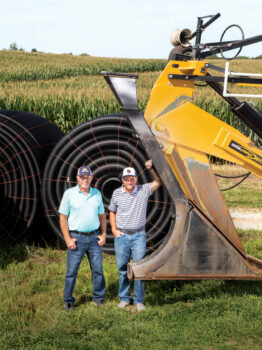
Growing up on the family farm, fourth-generation grower David McGaughey doesn’t remember a time when conservation wasn’t a top priority.
“As far back as I can remember, we’ve always had grass waterways or different drainage structures,” says David, who runs McGaughey Farms with his dad, Jim. “It seems like there’s always been projects happening where we’ve tried to take care of erosion and protect the land we have.”
Started in 1923 by David’s great-grandparents, Lafe and Ivyl, to provide enough corn, wheat and oats to feed their family and the livestock, the Bainbridge farm turns 100 this year. Jim’s father, Hubert, took the reins in the 1950s, and Jim, who still lives in the original farmhouse, assumed the leadership role in the mid-1990s.
Over the years, McGaughey Farms has evolved from 300 acres to a total of 2,500, including rented land, and now raises corn and soybeans for commercial use. As the farm has grown, so has its place as a role model for sustainability.
Going With the Flow
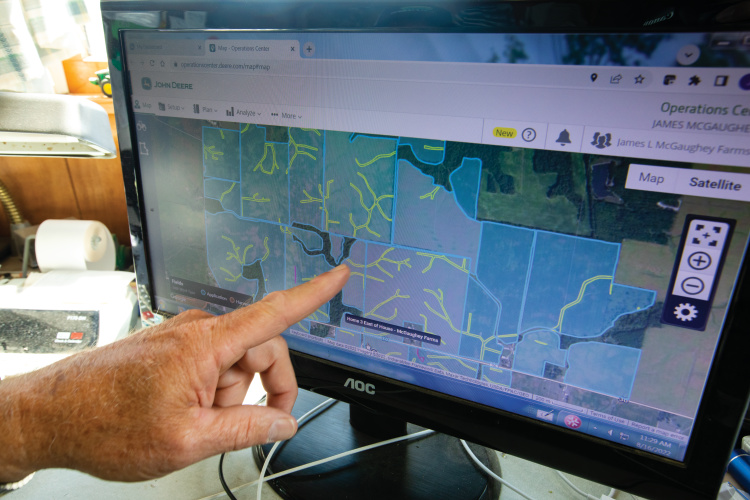
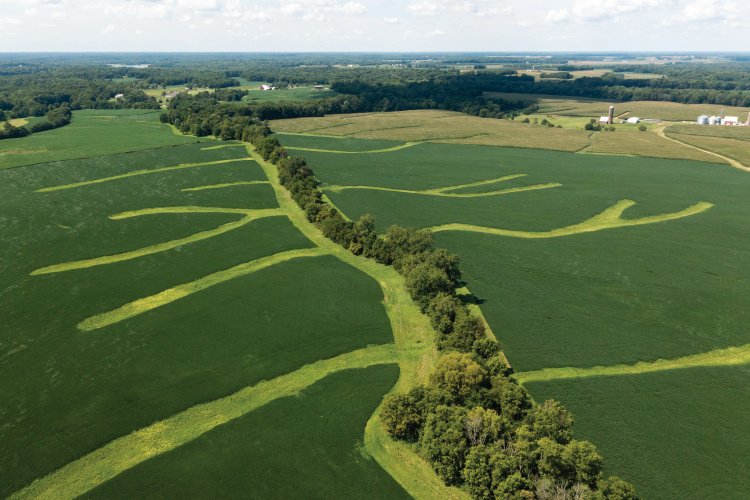
Sitting between two watersheds at the top of a hill, the McGaugheys’ rolling property is prone to excessive runoff.
“We always have to be aware of what that water is going to do because we face a lot of erosion challenges just because of the topography of our ground,” David says.
It’s not a new challenge, either. Jim watched his dad, Hubert, build waterways, install tile ditching and construct primitive rock dams around the edges of the fields to control erosion. In the 1940s, Hubert and Lafe built terraces in one field.
Today, McGaughey Farms features more than 100 acres of grass waterways designed to move water across fields and reduce the negative effects of flow on croplands. The practice, which is part of the U.S. Department of Agriculture’s Conservation Reserve Program, uses grass as a natural filter, trapping vital nutrients that would otherwise be washed away.
See more: Indiana Seedling Program Helps Reestablish 3,850 Acres of Forest a Year
No More Tilling
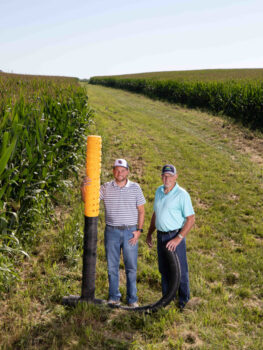
In the early 1980s, the USDA’s Natural Resources Conservation Service approached Hubert and Jim with an idea: Would they plant a field of no-till corn?
“They were wanting to put in satellite fields around the county they could look after,” Jim says. “They were having some issues with soil sediment getting into the lake south of our farms. We agreed to do that, and we are now 100% no-till.”
Given the tricky terrain of their farm, most of the McGaugheys’ conservation practices focus on erosion control. They also plant cover crops as well as filter strips, wide grass sections running alongside creeks that serve as natural collectors for eroded soil, stopping it from ending up in the waterways.
In addition, water and sediment control basins slow down and contain runoff from fields, keeping nutrients in the soil.
“Selfishly, we don’t want to lose them because we pay a lot of money to get that fertilizer there,” David says. “But we also recognize the harm that can be done when those nutrients reach the water supply. So, we’re very cautious to keep the nutrients in the fields where they belong.”
See more: New Generation Dairy Embraces Sustainable Practices to Protect Farmland and the Planet
More Than a Business
For the McGaugheys, protecting natural resources is a way of life.
“A lot of it has to do with an attitude about what we do,” David says. “Farming is a business, but it’s more than that. We’re trying to be very aware of the responsibility that we have to be good stewards of the resources that we’ve got under our control. There aren’t very many people that are in charge of protecting the amount of ground that farmers are in control of.”
The McGaugheys are also mindful of the impact on younger family members, like David’s two daughters, ages 7 and 10.
“We want to do the right thing, to take care of it not just for ourselves, but for our neighbors, our communities and future generations,” David says.
Years ago, when the farm was transitioning to a no-till approach, a longtime soil consultant advised Jim and David, “You have to make sure that you do it right the first time. You don’t always get a do-over.”
This advice stuck with the McGaugheys and continues to influence their farming strategy.
“You do have to be patient,” Jim says. “A lot of times, the neighbors get out early in the spring, and they start planting while we’re still sitting in the barn lot waiting for the conditions to be right. Our goal for conservation is a total package. Any one practice helps some, but when you put them all together, you will reap the most benefits.”
See more: Hydroponic Farming Takes Root in Indiana
An Award-Winning Farm
The McGaugheys have prioritized conservation for more than a century. Here are a few highlights that recognize their outstanding achievements.
- 1950: Jim’s grandfather, Lafe, won the Master Conservationist Award for Putnam County.
- 1995: Jim and his father, Hubert, were named Putnam County Conservationists of the Year.
- 1998: Hubert received the Prairie Farmer Master Farmer Award, which honors individuals who have contributed heavily to Indiana agriculture and demonstrated success in farming efficiency, stewardship of natural resources and community service.
- 2021: Jim and his son, David, won a River Friendly Farmer Award, a statewide initiative recognizing farmers who, through good production management practices, help keep Indiana’s rivers, lakes and streams clean.


Great story, great folks!
Congratulations!! This was very much deserved.I have known the family for years……they are wonderful people.