While Indianapolis may be best known for the sport of motor racing, bike pedals – rather than gas pedals – have been gaining speed for more than two decades now. Indianapolis even landed on Bicycling magazine’s “Top 15 Biking Cities” list, thanks in part to the Monon Trail.
The Monon Trail is considered to be one of the best of Indianapolis’ 59 bike-friendly trails. Originally the site of the Monon Railway, this bustling 27-mile paved stretch is a model example of rail-to-trail transformation.

Former Mayor Greg Ballard credits the trail with paving the way for this comprehensive conversion. Under his leadership, along with direction from community advocates and partnering agencies, Indianapolis expanded from a mere 1 mile of bike-friendly pathway to more than 200 miles.

This led to the Monon Trail being inducted into the Rails to Trails Conservancy’s Hall of Fame. The prominent distinction has only been awarded to 40 rails-to-trails projects nationwide, including one more in Indiana: the Cardinal Greenway. Double in distance at 61 miles, the Cardinal Greenway may boast more pavement, but because of its locale and attractive attributes, the Monon Trail still garners more bicycle and walker traffic.
“The Monon Trail is safe and accessible to a large number of households and visitors,” says Karen Radcliff, vice president and chief strategy officer of Hamilton County Tourism. “Trailheads and entry points are plentiful, with free parking, signage, bench seating, bathrooms and other amenities.”
See more: Rotary Jail Museum Circles Back in Time

A Bicycle Network
Formerly known as the “Lifeline of Indiana” during its railroad era, the converted corridor is now referred to by many as the “Bicycle Highway.” That’s because the Monon Trail grants convenient connections between cities, with plenty of entry and exit points throughout Indianapolis’ northern suburbs.
The Monon Trail, which launched in 1999, has become a sort of researched roadmap for other rail-to-trail transformations. Indiana University Indianapolis and Purdue University in Indianapolis led studies on the urban nature of the Monon Trail. Key findings from these assessments helped shape best practices for other rail-to-trail conversions.
Plus, the Monon Trail was incorporated into the U.S. Bicycle Route 35 (USBR35), an official bike interstate route starting in upper Michigan and continuing through Kentucky. Spanning roughly 360 bike-friendly miles, the USBR35 is an interconnected national network of paved pathways and roadways that grant bicyclists travel options extending from county to county.
See more: Knollbrook Farm Offers Festive Fall Activities to Entertain and Educate

Pedaling to Pastimes
Learn More
To start planning a Monon Trail itinerary, check out visithamiltoncounty.com/things-to-do/outdoors/monon-trail.
Radcliff says people can leisurely tour the Monon Trail from Indianapolis to Carmel to Westfield to Sheridan with access to restaurants, bars, shopping, art galleries and many other pleasures.
The possibilities for locals and visitors alike are practically endless. Carmel, for instance, has more than 230 miles of side paths and trails in the city limits open for exploration, such as the easy-to-tackle 1.4-mile paved Hagan-Burke Trail.
“Carmel has something called the Carmel Access Bikeways Loops, which are five distinct loops that bicyclists can use to explore the city,” says Rebecca Carl, City of Carmel chief marketing officer. “The routes are on trails and low-trafficked streets and are marked with either signage or on-street route markers.”

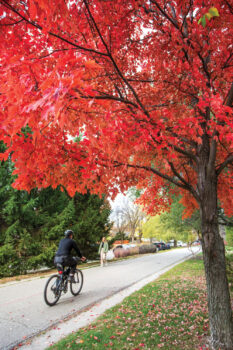
Bicyclists should familiarize themselves with safety marking and signage. For example, “sharrows” are street markings used to indicate a lane that’s shared by both bicycles and cars. These markers are used in spots where it may not be clear as to where bicyclists should be riding, such as at intersections with multiple turn lanes.
Likewise, a green lane identifies places where bicycles and cars may be more likely to come into conflict. In these instances, motorists should cross bike lanes only where the pavement markings are dashed. Additionally, bicyclists should employ extra caution when riding along or across green lanes.
Bicyclists should always utilize proper safety equipment as well, including helmets, proper clothing and lights.
“The Monon Trail widens in Carmel Midtown to allow for the volumes of people who enjoy this urban playground, where live music and watch parties are the norm,” Radcliff says. “The Monon Trail also intersects in Westfield at the Midland Trace Trail that now offers a new award-winning Grand Junction Park and a row of cottage restaurants. Just north of Westfield, the Monon Trail travels through Grand Park Sports Campus, the nation’s largest youth complex of its kind, attracting over 5 million visitors each year.”

Radcliff also says trail users appreciate the connection to Indianapolis’ Cultural Trail, which winds through various cultural districts. Broad Ripple, for example, is a draw for eclectic shopping, turtle watching from the bridge and a brewery pit stop. Additionally, many local events and festivals within the vicinity of the Monon Trail offer bike storage to accommodate pedal-powered patrons.
See more: Bluespring Caverns Invites Visitors to Stroll in the Deep