


After the 2018 farm bill removed hemp from the U.S. Drug Enforcement Agency’s Schedule 1 list, legal cannabis charged into Indiana’s agriculture sector full of promise as a potential cash crop with market applications as cannabinoid (CBD) health products, foods and fiber.
Initially, cultivation was regulated through a research-only pilot program, but in 2021, the Indiana State Hemp Plan ushered in commercial production. Today the nascent industry is slowly finding its footing.

“We had a ton of growers in 2019 because everyone was kind of jumping on board,” says Marguerite Bolt, hemp extension specialist with Purdue University’s Department of Agronomy. But like many other states, Indiana saw a decrease in registered production acres in 2020 and 2021.
Don Robison, seed administrator for the Office of the Indiana State Chemist, which acts as a regulator for the State Hemp Plan, says grower participation has declined sharply since 2019. That year, nearly 400 licenses were issued statewide, compared to 133 in 2021. Robison predicts the number will dip again this season.
A Different Kind of Crop
Sagging CBD biomass prices caused by nationwide overproduction on the heels of the 2018 farm bill is one deterrent. And processing is another issue, says Robison. There are currently only about seven commercial CBD processing facilities in the state, and none for fiber or grain products.
Additionally, intentional and unintentional fraud has plagued the fledgling industry, which currently has no civil penalties. Strict crop reporting requirements around planting and harvest times, as well as sampling to ensure compliance with the U.S. Department of Agriculture’s legal limit of 0.3% THC (tetrahydrocannabinol, the primary psychoactive compound in cannabis), have proven challenging for both regulators and farmers. To make reporting easier for growers, the state invested $250,000 into developing user-friendly management software that, Robison says, has been nominated for a national award.
There are also some wrinkles still being ironed out with hemp on the agronomy front, Bolt says. In the beginning, genetics and material sourcing were a new frontier for breeders and seed brokers.
“There was a level of uncertainty as to whether THC content was going to remain below the legal threshold,” she says. “Each year, we’ve seen destruction orders go down, which means our growers are starting to figure out genetics that work.”
Weeds, weather, insects and disease are also keeping growers on their toes. Hemp is heavily impacted by weed pressure, yet there are no conventional herbicides labeled for use with the crop, and many farmers are trying not to use any chemical products at all, Bolt explains.
Indiana’s early-season rainfall is problematic for a plant that prefers to keep its feet dry. “The first couple weeks of its lifecycle, it’s kind of a wimpy plant that wants everything just right,” she says.
See more: Indiana Businesses Celebrate Locally Grown Ingredients Through Malts and Spirits
Seed to Shelf

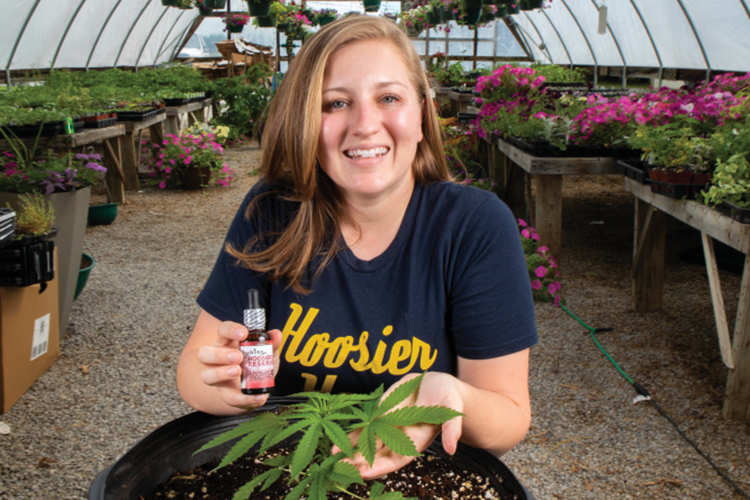
Kelly and Joe Linne were working full-time jobs and growing vegetables on their 10-acre farm in Clark County when they decided to jump on the Indiana hemp train in 2019. Among the first 100 license holders in the state, they started small, planting a little less than an acre that year.
“We had a lot of ups and downs,” Joe Linne says. “Soil, bugs, too much water, not enough water – all kinds of things.”
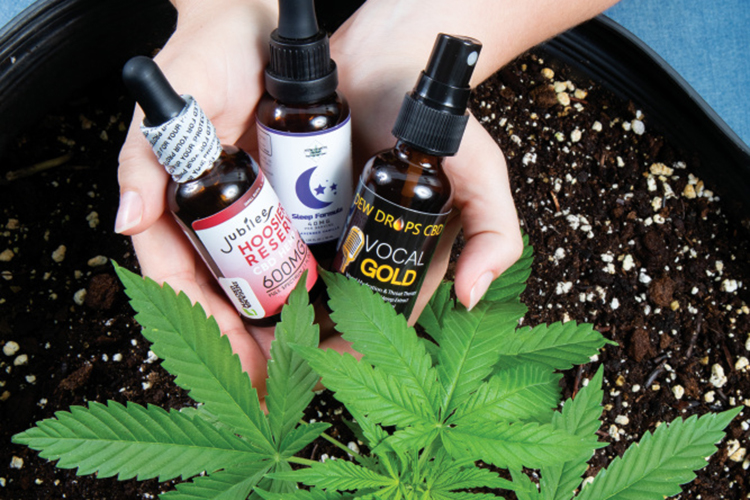
They processed their own harvest and worked with retailer Jubilee of Wellness to bring their CBD oil to market. But 2020 was a challenging year, and after being required to burn that season’s crop because it was above the THC legal limit, the couple decided to pivot to the retail side of the industry.
In 2021, the Linnes partnered with certified medical assistant Gina Emerson to launch Hoosier Hempster Dispensary, a New Albany-based business specializing in Indiana- and Kentucky-grown “seed-to-shelf” hemp products, including their own Hoosier’s Reserve CBD brand.
Despite current market challenges for farmers, the Linnes see opportunity in growing craft CBD hemp. And they are working with the Midwest Hemp Council to advocate for a reversal of the state’s 2019 legislation banning smokable hemp flower, a profitable commodity for growers.
As an educator, Bolt works to ease the rigors of the learning curve for farmers by providing information about emerging hemp research. An ongoing project at Purdue University is exploring how hemp can fit into an organic row crop system. There are hemp propagation and variety trials, food science studies, and integrated pest management and disease research projects underway across the state.
Both Bolt and Robison see a potential shift in the industry to a grain and fiber focus. Robison is particularly encouraged by a group of farmers in Shelby County making intentional efforts toward establishing a fiber-processing facility.
Over the next five years, he sees prospects improving for Indiana hemp farmers. But his advice to anyone looking to get into the industry right now is to start small.
“Like any new industry, there’s going to be fraud. There are going to be people who don’t know what they’re doing and a steep, steep learning curve for everybody,” Robinson says. “But long-term, I think the outlook is going to be pretty good.”
Hemp History
- Hemp, also known as industrial hemp, is primarily grown for its use as an oil and fiber. Vastly different from marijuana, “hemp” refers to varieties of cannabis that contain 0.3% or less THC (tetrahydrocannabinol) content.
- In 2019, the Indiana State Department of Agriculture issued hemp production licenses to nearly 400 farmers. The number dropped to 133 in 2021.
- Hemp is a high-yield crop. One acre of hemp produces twice as much oil as 1 acre of peanuts, and nearly four times as much fiber pulp (for paper) as an acre of trees.
- Hemp was one of the first domestically cultivated plants. Evidence of hemp fabric dating back 8,000 years has been found in Turkey.
- Hemp contains the strongest natural fiber of any source and also withstands the test of time. Unlike wood-based paper, hemp paper that is hundreds of years old found in museum archives has not yellowed.
Sources: Indiana State Department of Agriculture, National Hemp Association
See more: Pandemic Prompts New Partnerships and Increases Access to Local Foods


Thank you for nice information
https://uhamka.ac.id/
Great blog! Thank you for sharing this amazing article.
Liquid Carbon for Agriculture
thanks for information and nice blog. please visit website https://unimudasorong.ac.id/