When you visit a children’s museum dedicated to sports mascots, you find vibrant exhibits exuding the same energy and intensity as the mascots the museum honors. Take a closer look, however, and you’ll discover each colorful exhibit at the Mascot Hall of Fame (MHOF) is rooted in STEAM (science, technology, engineering, arts and math) educational principles.
By trying on heads and weighted vests, you learn more about the different shapes, sizes and weight distribution of various mascots. You can brush up on your geography by matching more than 150 mascots to their hometowns. You can create your own rendering of a mascot, both with crayons and computer software.

“We did not want to be a single-purpose facility,” says Al Spajer, MHOF director of community engagement. “From the first ideas, we thought if we could blend the theme of mascots, which in itself is a fun and exciting topic, with some elementary-level educational principles, we’d have a winner on our hands.”
See more: All Aboard the Nickel Plate Express
Making Silliness a Science

If You Go
Mascot Hall of Fame
1851 Front St., Whiting
Phone: 219-354-8814
Website: mascothalloffame.com
Hours: 10 a.m. to 5 p.m., Wednesday through Saturday
The MHOF was founded in 2005 by David Raymond, the original portrayer of the Phillie Phanatic character, as an online repository honoring sports mascots. In 2013 Raymond began exploring the idea of a physical MHOF museum with the city of Whiting, a small city on the southern shore of Lake Michigan.
Spajer served as the MHOF’s first executive director and says everyone involved with the project, from the professional mascot community to Whiting officials, sought expert advice from local universities to incorporate educational objectives into the exhibits.

The result is a three-story, 25,000-square-foot facility with glass walls around three-quarters of the building. “It’s spectacular,” Spajer says of the space, which opened in December 2018.
Each exhibit centers on one of the principles of STEAM. For example, in the Science of Silliness Lab, players choose from four unique mascots and race against each other in sprints. Proper food and drink choices get a player to the finish line before his or her opponents.
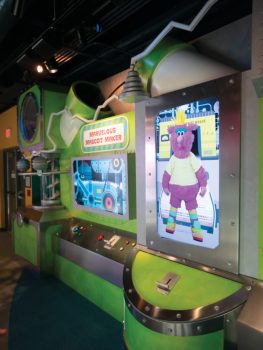
Visitors also can try on mascot heads and other components of a mascot outfit. They also have an opportunity to do a workout routine wearing the weighted vest and check their pulse rates to gain an understanding of the physicality required of mascot performers.
“Costumes weigh between 25 and 30 pounds,” Spajer says. “A lot of people think there is a small air conditioner located within the costume. That’s not the case.”
Spajer’s favorite exhibit is the Centier Bank Sports Court, where visitors can make a basket, shoot a puck, score a touchdown, pitch a baseball or kick a soccer ball using equipment made of polyurethane foam, the material mascot costumes are made from.
Another popular exhibit is Strut Your Stuff, where visitors learn a routine as if auditioning for a mascot role. “You perform in front of a green screen and then you can email the results of your routine to yourself,” Spajer says.

The ultimate fan favorite, however, is the three-story atrium entrance, which features gigantic, inflatable heads of the 26 mascots who’ve been inducted into the Hall of Fame.
“This is the exhibit that gets the most attention,” Spajer says.

Hoosiers will appreciate the inclusion of Blue (Indianapolis Colts) and Boomer (Indiana Pacers). Chicagoland is well represented with Benny the Bull (Chicago Bulls), Southpaw (Chicago White Sox) and Tommy Hawk (Chicago Blackhawks).
The character that started it all, the Phillie Phanatic, was a member of the inaugural class of mascots.
The MHOF even has its own mascot in Reggy, the Purple Party Dude. “He is our signature character, and we tell kids Reggy lives in the Mascot Hall of Fame,” Spajer says.
See more: Reconnect With Your Agricultural Roots at Fishers AgriPark
All Ages Can Play (and Learn)

“We try hard to be proactive on multiple fronts,” says Spajer, noting the museum welcomed 35,000 visitors in 2019, the MHOF’s first year before the pandemic forced a 13-month shutdown. “If we can do anything to spark that ‘lightbulb going off’ moment when attendees interact with our exhibits, then we’ve been successful.”

Tommy Hawk made a special appearance at the MHOF in fall 2021. The museum staff organized a hockey game for a group of senior citizens who use the MHOF every Wednesday. The seniors, ages 75 to 90, use the museum’s foam pucks and sticks for a “colossal senior hockey game on a makeshift rink” in the atrium.
The same group of seniors enjoyed a rousing game of whiffle ball in the summer of 2022, with Southpaw as master of ceremonies.
Such community engagement, which also includes school field trips and private events, is an essential component of the MHOF’s mission statement.
“The way we think about it, age doesn’t really matter,” Spajer says. “When you come here, you can be a kid again. If you want to have fun and learn at the same time, we provide that opportunity for anyone who walks in our door.”
See more: Discover Nine Places to Clown Around in Peru, Indiana