


What happens to racehorses when they’re no longer fit for the track?
A significant number make their way into Thoroughbred aftercare programs, and Mooresville’s Friends of Ferdinand is the state’s only such nonprofit accredited by the Thoroughbred Aftercare Alliance. The organization emphasizes retraining horses for new careers and matching them with suitable adopters.

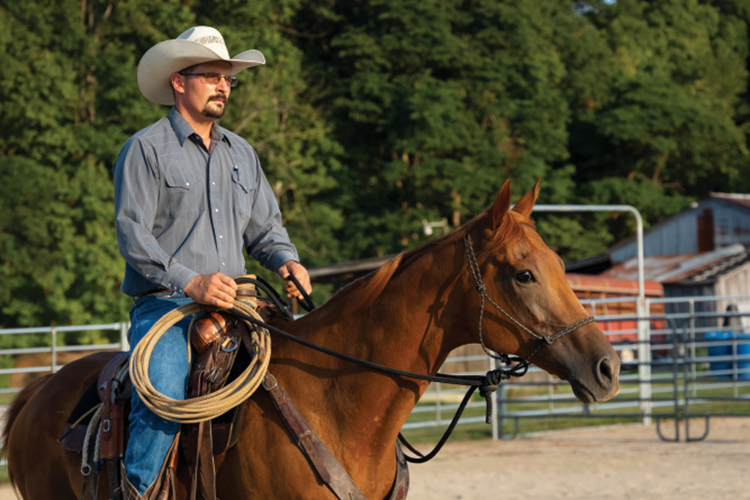
“Our mission is to get these horses retrained and into forever homes, so the focus for the organization as a whole is on quality over quantity,” says Brandon Fortner, Western trainer for Friends of Ferdinand.
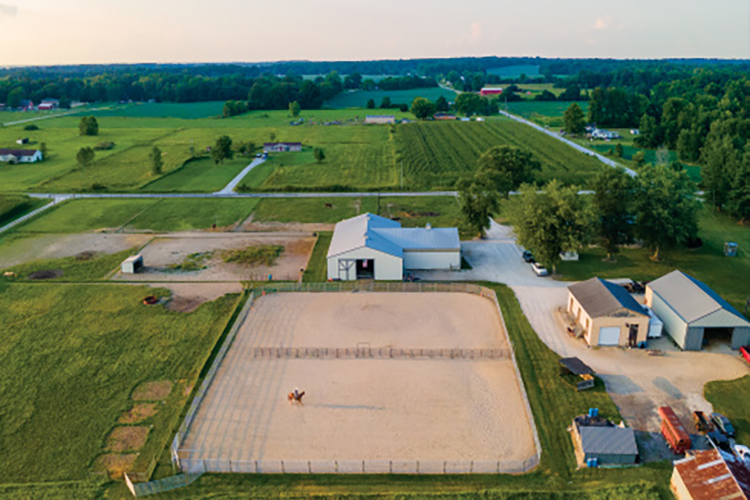
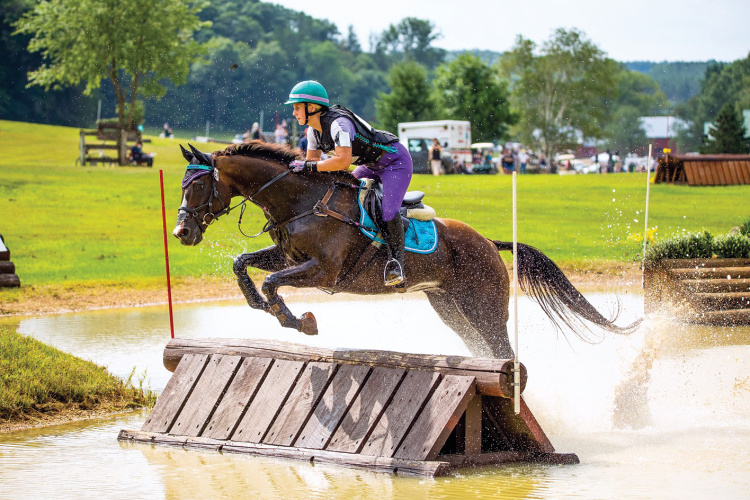
At his farm in Quincy, Fortner trains up to three head at a time in Western disciplines including roping, working cattle and trail riding. Another trainer in Ohio works with other horses in the program on English disciplines, such as jumping and dressage.
“These Thoroughbreds can do anything any other horse can do,” he says. “They have the ability and the brains, the drive and desire. They’ll give you everything they’ve got to get the job done.”
New Quarters
But first, they spend some time just learning to be a horse again.
In what the organization calls the “let-down phase,” horses transitioning from the racetrack are given needed time to decompress. If they’re injured, they receive medical rehabilitation. This phase is also beneficial for revealing the horses’ personalities and natural skills, Fortner says.
Horses come to Friends of Ferdinand in a variety of ways, usually through referrals from racetracks, owners or breeders. All are vetted upon intake, and after the transition time, each gets professional retraining for at least 30 days.
The adoption process is just as thorough. It consists of an extensive application that includes a horse care plan and references from a farrier, trainer and veterinarian. Next, potential adopters visit the facility at least once to view and ride the specific horse they are interested in adopting. This allows both potential adopters and horses to become acquainted with each other, Fortner says. Then, if the fit is good, potential adopters are given a 30-day adoption trial, which helps ensure the animals settle in well and are evaluated by the adopters’ farrier, trainer and vet.
Anytime within that 30-day trial period, an adopter can decide the horse is not a good fit and return the animal for a refund of the adoption fee.
In fact, any horse from Friends of Ferdinand can always come back.
“All these buffers are in place so a horse can come back anytime something changes, and its adopter can no longer keep it. They always have a place to go. Of course, the goal is to have them not come back,” Fortner says.
That goal is generally achieved. In the organization’s 15-year history, 95% of its horses have stayed with their adopter.
See more: The Healing Power of Horses for At-Risk Youth
Stomping the Stigma
While few people outside the horse or racing industries may be familiar with Friends of Ferdinand, its successful mission of combining horse retraining and adopter matching is essential. That’s because the average horse lives 25 to 30 years, though Thoroughbreds typically retire from racing when they’re only 5 to 7 years old.
“Traditionally, racehorses have had a stigma of being high energy and hard to handle, and they can be,” Fortner says. “But we show over and over that stigma can be overcome with proper training and matching the personality and skill level of the horse and adopter.”
Instead of having their whole lives ahead of them, former racehorses without those two key factors to their advantage sometimes acquire a reputation for being too temperamental and end up in a slaughter pipeline. Unfortunately, injured racehorses sometimes end up there too.
That revelation resulted in the idea that formed the organization, which was founded by two horse race enthusiasts, both named Jim. When “the Jims” learned the fate of some Thoroughbreds from a breeder at Hoosier Park, they purchased every horse that failed to receive a minimum bid at a 2005 paddock sale hosted by the racetrack and the Indiana Thoroughbred Owners and Breeders Alliance.
To learn more about the organization, visit friendsofferdinand.com, email contact@friendsofferdinand.com or write to Friends of Ferdinand Inc., P.O. Box 262, Mooresville, Indiana, 46158.
Friends of Ferdinand got its name from a former champion that was reportedly sold for slaughter after a racing career that included winning the 1986 Kentucky Derby and the 1987 Breeders’ Cup Classic as well as being voted the 1987 Eclipse Award for Horse of the Year.
“I’ve found that these horses are accepting of learning a new job,” Fortner says. “They have a great mindset and fantastic work ethic. We may not move as many as some other Thoroughbred aftercare agencies, but because of the attention we give the entire process, we hope none of our horses meet the same fate as Ferdinand.”
See more: Get Up Close and Personal with Adorable Alpacas in Peru, IN


I have the delight in adopting Filly Named Billy. Friends of Ferdinand and Brandon Fortner are excellent in guiding people through the process. I had originally been looking at a different mare. Brandon spoke with me for quite a while then suggested what he felt was a good fit. Billy! A perfect fit and my horsehusband loves her too. Friends of Ferdinand have kept in touch and have always answered all of my questions. I also received previous vet records! I am so grateful to everyone for finding me Billy!
Looking for a riding horse and companion.